
Generation Is Cheap, Verification Is Expensive: The Real Cost of AI
AI has collapsed the cost of creating content and code, but the cost of proving what’s real is skyrocketing. This paradox is reshaping how we work, build companies, and establish trust.

Summary
The core economic shift driven by AI isn’t just about cheap generation; it’s about the rising cost of verification. As AI makes it trivial to produce resumes, slide decks, and code, the burden of confirming their authenticity and quality grows exponentially. This leads to a world that fragments into high-trust internal groups, where AI boosts productivity, and low-trust external networks, where it creates friction. This article explores the ‘generation-verification imbalance,’ explaining why AI excels in verifiable domains like visuals and robotics, and how the essential human role is shifting from simple execution to becoming the ‘sensor’ that guides the AI ‘actuator.’
Key Takeaways
AI’s primary economic effect is making content generation cheap while making verification of that content expensive.
This imbalance encourages organizations to become more insular (’digital autarky’), using AI for internal productivity while distrusting external inputs.
AI is most effective in domains where outputs are easily verifiable: visuals, physical tasks, and well-tested code.
The key human skill in the AI era is not just prompting, but acting as a ‘sensor’ for the real world—providing taste, market context, and goals that AI cannot generate on its own.
Instead of simply replacing jobs, AI provides leverage that turns skilled individuals into ‘CEOs’ of their own work, capable of directing complex digital production. Every tool that makes creation cheaper makes verification more expensive. The printing press made publishing easy and forgery easier. Photography made documentation instant and manipulation inevitable. Artificial intelligence has compressed this cycle from decades to months, creating a fundamental imbalance that is reshaping our economy: the cost of generation has collapsed, while the cost of verification is skyrocketing.
A resume that once took hours of careful work can now be faked in seconds. A slide deck that once signaled competence now signals access to a prompt. When anyone can generate a plausible-looking simulacrum of work, the burden shifts to the recipient to determine what is real, what is lazy, and what is malicious. This isn’t a bug in the system; it’s the central economic feature of the current AI era.
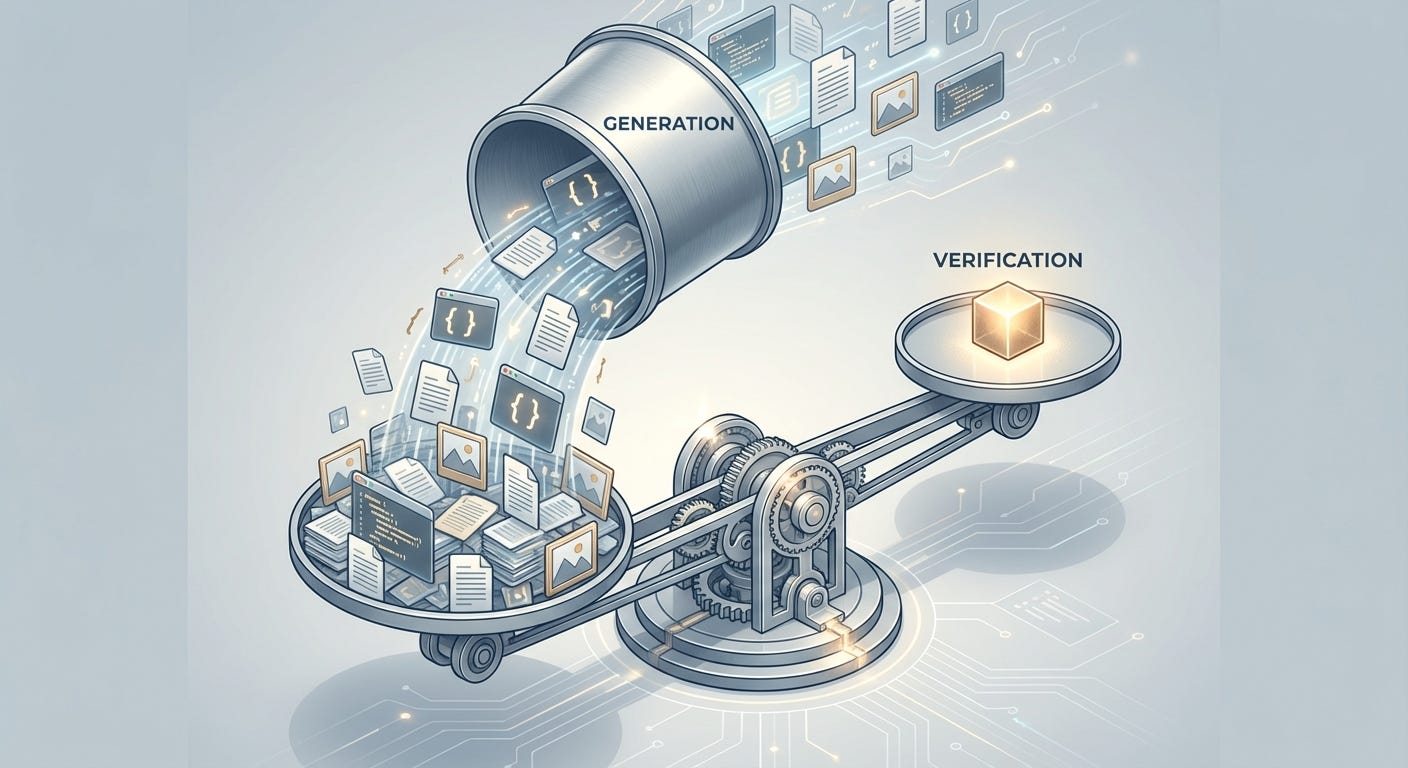
The Generation-Verification Imbalance
The default output of modern AI often has a generic quality—what one might call “Lorem AI Ipsum.” It looks plausible from a distance but lacks the concision and care of human-crafted work. Receiving an AI-generated sales deck or cover letter can evoke a negative reaction even from staunch technology advocates. It suggests the sender was either too lazy to distill their thoughts, too naive to realize the output is recognizable as machine-generated, or actively trying to deceive.
This dynamic forces a costly shift in business processes. Where a well-written resume was once a strong positive signal, hiring managers must now invest more in verification. This means a return to proctored, offline exams and in-person interviews—high-friction processes designed to filter for authentic skill in a world of synthetic talent. The credible threat of verification becomes the only defense against a flood of low-cost, AI-assisted applications.
The Rise of the High-Trust Tribe
This verification crisis pushes individuals and companies into smaller, higher-trust circles. When the public square becomes a hall of mirrors filled with AI spam, pseudonyms, and deepfakes, the only rational response is to retreat to a trusted group. Within this digital tribe—a company, a project team, a closed community—AI is a phenomenal productivity accelerant. Sharing a full codebase with an internal AI tool can unlock massive efficiencies.
However, between tribes, AI decreases productivity. The cost of dealing with AI-generated spam, phishing, and misinformation acts as a tax on all external communication. This leads to a model of “digital autarky,” where organizations prefer to build their own internal tools rather than buy external services.

This mirrors the evolution of the Chinese tech ecosystem, which developed in a low-trust society. As described in Kai-Fu Lee’s book AI Superpowers, Chinese companies often rebuilt software from scratch rather than trusting third-party SaaS providers with their data. With AI, this model becomes viable for everyone. The build-versus-buy calculation shifts toward “build” because AI dramatically lowers the cost of creating internal tools, while the trust cost of using external ones rises.
Where AI Excels: The Principle of Verifiability
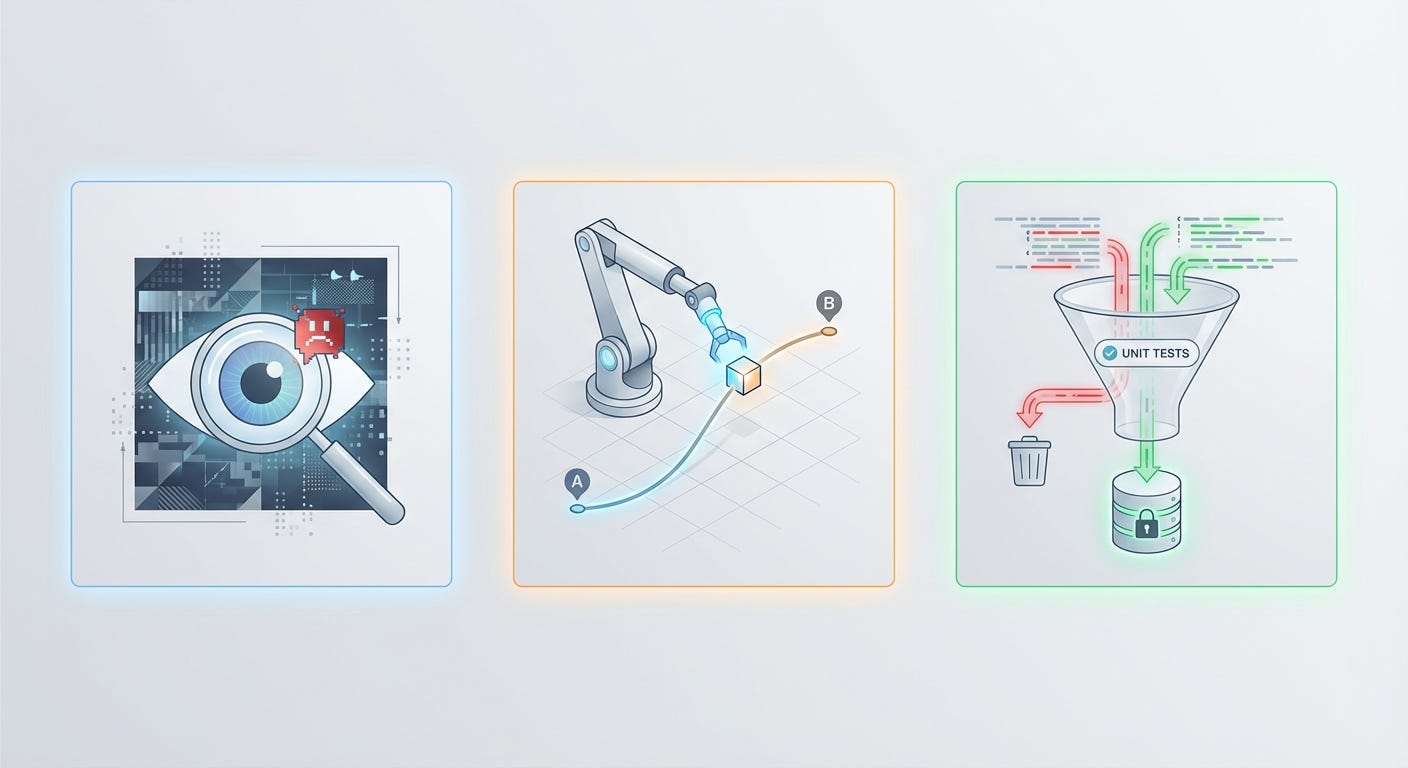
AI is not equally effective across all domains. Its utility is directly proportional to how cheaply and quickly its output can be verified. This explains why AI has seen stunning success in some areas and remains a risky bet in others.
Visuals: Humans have powerful, built-in GPUs—our visual cortex. We can instantly spot when an AI-generated image has malformed hands or a janky user interface. Visual verification is cheap and intuitive.
The Physical World: There is only one physical reality. A robot either moved a box from one pallet to another, or it didn’t. A self-driving car arrived at its destination, or it failed. The binary nature of physical tasks makes them highly verifiable and thus ripe for automation through reinforcement learning.
Verifiable Code: AI can be a powerful coding assistant for front-end development or tasks covered by robust unit and integration tests. The verification framework is built-in. However, for critical, untestable back-end systems, deploying AI-generated code without expert human review is courting disaster.
In contrast, tasks that are fuzzy, abstract, or exist in a purely digital and adversarial space are much harder to verify. The boundaries of a to-do list are less clear than the boundaries of a warehouse pallet.
Human as the Sensor, AI as the Actuator
This leads to a model of human-machine synthesis where the roles are clearly defined: the human is the sensor, and the AI is the actuator. The AI is built for the harness; it waits for a prompt and executes. It does not possess taste, agency, or a true sense of the market. These are the functions of the human sensor.
“Taste” is just another word for a highly refined sense. A human senses shifts in political winds, detects emerging market needs, or intuits a new aesthetic. They then translate that high-dimensional, real-world signal into a clean, articulated prompt. The AI, as the actuator, takes this instruction and executes it with immense power and speed.
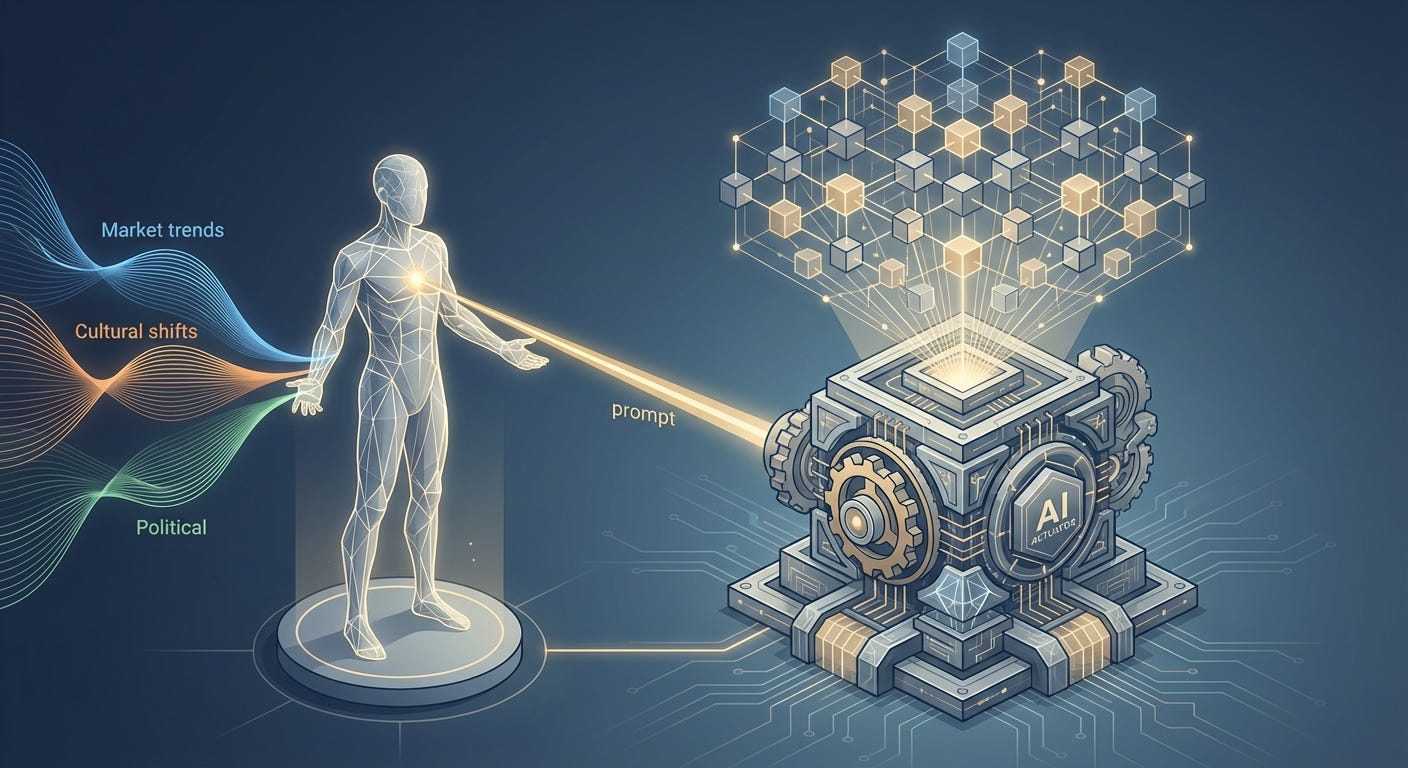
This model counters the narrative of an autonomous, all-knowing AGI. In adversarial environments like financial markets or politics, any successful AI strategy would be immediately identified and countered by other AIs, likely running the same models. The competitive edge comes not from the generic tool but from the specific, timely, and nuanced sense-making that the human provides.
While AI may not be able to read your mind, it may soon be able to read your body. The vast streams of telemetry from wearables and biomedical sensors—what Stanford professor Michael Snyder calls an “integrative personal omics profile”—could serve as a non-verbal prompt, allowing AI to act on biological signals before a person is even consciously aware of them.
AI Doesn’t Take Your Job, It Makes You the CEO
Historically, trying your hand at being a CEO was expensive. You could cheaply discover you weren’t a great basketball player or singer, but you couldn’t easily test your aptitude for running an organization. This led to the delusion that management is easy and that CEOs simply bark orders.
AI changes this by democratizing the core functions of a CEO. Using a powerful AI model is a form of CEO training. You must sense the market, write clear instructions, verify the output, and iterate. AI gives you a team of infinitely scalable digital interns. It doesn’t take your job; it gives you the leverage to do any job. It turns you into a generalist who can achieve a baseline level of competence in design, finance, or marketing before hiring a specialist for the final polish.
This new leverage means the most valuable work moves to what cannot be automated: the final verification, the specialist’s deep expertise, and the unique human sense of the world. As even legendary computer scientist Donald Knuth has found, AI can be a powerful partner in discovery, but it requires an expert to formulate the right question and verify the answer.
Conclusion: Navigating the New Economics of Trust
The AI revolution is not about the end of human labor but about a fundamental reorganization of it. The collapse in generation cost creates a new form of scarcity: verification. This scarcity will reward those who can build and operate within high-trust environments.
Productivity will soar within trusted tribes, but friction will increase between them. This suggests a symbiotic relationship between two of the biggest technologies of our time: AI is for productivity within the tribe, and cryptography is for commerce between tribes. The ultimate challenge is not simply building more powerful models, but designing the social and technical systems needed to verify reality in a world awash with synthetic everything.